Your Cable Is Stealing Your Lunch Break (and Possibly the Rest of Your Day)
In a digital forensics lab, we agonise over CPU choice, write blocker brands, and software licences that cost more than a small car (or house in some cases). Then we plug all of it into a £3 cable from a drawer and wonder why the extraction is taking long enough to finish a novel.
The cable matters more than it has any right to. Not because of the headline bandwidth printed on the sleeve, but because of the engineering inside, most of which is doing a worse job than you think.
The Numbers
A 128GB modern Android handset. Identical workstation and software. Four cables.
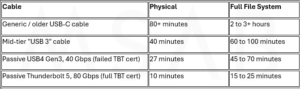
Worst to best, that’s over 70 minutes saved on physical and potentially more than two hours on full file system. Across an evidence queue, that’s not a coffee break or lunch. That’s half a day wasted on a single device!
If you’re wondering why FFS hurts more than physical despite extracting less data, it’s because FFS isn’t one long sequential read. It’s hundreds of thousands of small file operations, each carrying its own protocol overhead and, on a marginal cable, its own opportunity for a silent retry. Bad cables don’t average out across a long stream; they get multiplied across every file boundary, every database, every cached thumbnail, every chat attachment.
Bandwidth Isn’t the Answer
The obvious reading is that the faster cables were using their higher rated bandwidth. If only. Most current smartphones cap at USB 3.2 Gen 1 (5 Gbps) or USB 3.2 Gen 2 (10 Gbps), and none negotiate Thunderbolt or USB4 v2.0. Your phone has no idea what PAM-3 ternary signalling is, and frankly, it doesn’t care.
The top two cables in this test were running at the same negotiated link speed. Their gap happened within a single 5 Gbps link. The bandwidth headroom on the sleeve was, in both cases, decorative.
Certification Is the Real Signal
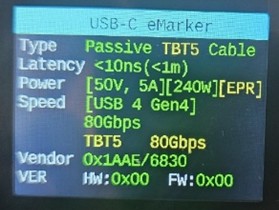
Both top cables passed USB4 testing on an eMarker reader. Only one passed Thunderbolt. The 40 Gbps cable failed TBT3, TBT4, and TBT5 across the board, a clean sweep of red Xs that read like a particularly bad school report.
80 Gbps cable eMarker report
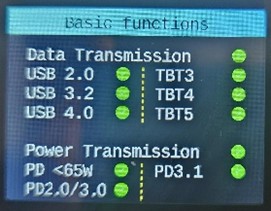
40 Gbps cable eMarker report
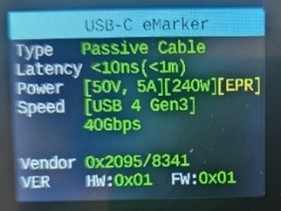
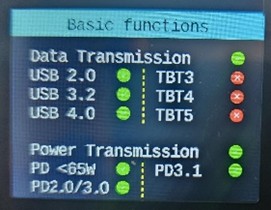
Thunderbolt certification is significantly stricter than USB4 certification. It demands tighter shielding, better impedance matching, lower insertion loss, and an eMarker chip that doesn’t tell creative stories about itself. A cable that flunks Thunderbolt can still advertise 40 Gbps in its eMarker, the same way a budget corner takeaway can advertise itself as «world famous”.
When the link is dirty, the host and device spend a chunk of every second silently retrying corrupted packets. The negotiated speed stays the same, but effective throughput goes through the floor. On physical, that’s where your morning is going. On FFS, that’s where your whole day is going.
Practical Recommendations
- Test cables with an eMarker reader before deployment. Cables lie. The sleeve says one thing; the silicon inside often says another. Cables also degrade with use, so retest the ones living in your kit.
- Treat Thunderbolt certification as a quality proxy. No smartphone you’re imaging will ever negotiate Thunderbolt. The spec doesn’t matter to the phone; the engineering rigour required to pass it does.
- Buy on certification, not bandwidth. «TBT4» or «TBT5» requires Intel’s sign-off. «80 Gbps» on the box means whatever the manufacturer felt brave enough to print.
- Don’t bottleneck the rest of the chain. Use a rear I/O port on the workstation, an NVMe destination drive, and a small fan to keep the phone out of thermal throttle. A great cable plugged into a tired USB-A breakout is a sad cable.
The Takeaway
Cable bandwidth is a marketing number. Cable certification is an engineering number. The difference, on a real evidence device, is over an hour on physical and most of an afternoon on full file system.
If you have a cable tester, use it. If a cable fails Thunderbolt certification, it’ll still get the job done. It’ll just take long enough that you’ll remember exactly which cable it was, and you’ll start to resent it. Don’t do that to yourself. Buy the good cable. Your evidence queue will notice.
Author:
Alex Coley
Technical Sales Engineer • Tech Sales
Related Blog

Traces for Deleted photo/video Under Apple Photos app
Read Full blog in PDF Establishing that a photograph or video was...

Trust is not a feature. It is the foundation.
Every piece of digital evidence tells a story. For that story to...

Green meets Blue: A brief RCS forensic excursion
WHAT RCS is? (Rich Communication Services) What can it do? WHO uses...